Retiring in Greenville, SC: Taxes, Healthcare, and the Real Tradeoffs
South Carolina does not tax Social Security, lets you deduct part of the rest of your retirement income, and exempts the first fifty thousand dollars of your home's value from property tax once you turn sixty five. That is the part people hear about. What they find out later is that the property tax benefits are not automatic. They are separate applications with their own deadlines, and one of them makes you wait a full calendar year of residency before it applies at all.
This is the retirement companion to our guide on whether Greenville, SC is a good place to live. For what daily life costs, see the cost of living breakdown, and for the first forty five days after you arrive, the relocation checklist.
What South Carolina does with retirement income
Three separate provisions, and they stack in a specific way that catches people out.
| Provision | Under 65 | 65 and older |
|---|---|---|
| Social Security | Not taxed by SC | Not taxed by SC |
| Retirement income deduction Qualifying retirement account income |
Up to $3,000 | Up to $10,000 |
| Age 65 and older deduction Against any SC taxable income |
Not available | Up to $15,000 |
| Homestead exemption Property tax, not income tax |
Not available on age | First $50,000 of value |
Figures from the South Carolina Department of Revenue and Greenville County Real Property Services, current at the time of writing. Verify against the SC1040 instructions for your filing year.
The catch is in the last two rows of the income tax section. The age sixty five deduction and the retirement income deduction do not simply add together. If you claim the retirement income deduction, you subtract that amount from the fifteen thousand. Claim the full ten thousand retirement deduction and you have five thousand of the age sixty five deduction left, not fifteen.
Both are worked out per person, not per return. The Department's language is an individual taxpayer and a resident taxpayer, so a couple who are both sixty five or older each run their own calculation rather than sharing one fifteen thousand between them. That is a meaningful difference on a joint return, and it is worth confirming with your preparer for your filing year.
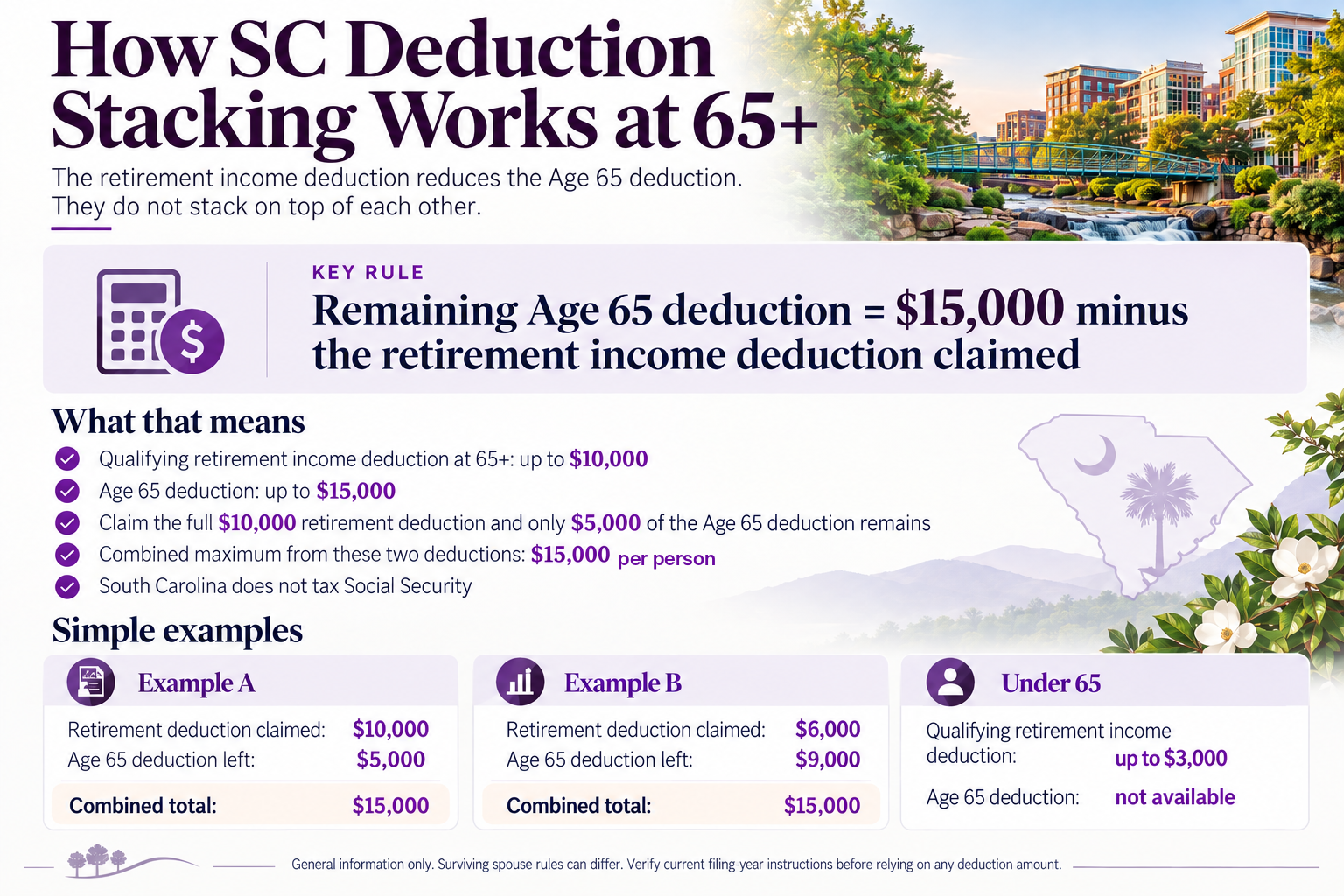
The two deductions share one ceiling. Claiming the retirement deduction reduces what is left of the age sixty five deduction.
Surviving spouses are treated differently. A surviving spouse can claim a retirement deduction based on the deceased spouse's age, and that one does not reduce the age sixty five deduction.
Social Security sits outside all of this. South Carolina does not tax Social Security benefits, or railroad retirement benefits, that are taxable federally. No form, no deduction, no cap.
What rate those deductions come off
A deduction is only worth the rate it offsets, and South Carolina changed its rates this year.
H. 4216 was signed on March 30, 2026 and applies beginning with tax year 2026, for returns due April 2027. It replaced three brackets with two. Income under $30,000 is taxed at 1.99 percent. Income of $30,000 and above is taxed at 5.21 percent minus $966. The same law decoupled South Carolina from federal deductions, so federal adjusted gross income is now the starting point for your state return, and a new state deduction replaced the federal standard deduction.
The top rate is scheduled to keep falling. Further reductions are tied to the state's Board of Economic Advisors projecting revenue growth of at least five percent, reviewed annually.
Check this one with a professional. That restructure is recent, the Department of Revenue has said further guidance is coming, and some pages on the state's own site still describe the previous rules. The deduction amounts in the table above come from the Department's retiree guidance. If you are building a retirement budget around any of these numbers, confirm them against the instructions for your filing year or with a CPA first.
The property tax rule that costs people the most
South Carolina taxes an owner occupied legal residence at four percent of fair market value. Almost everything else, including a second home, is taxed at six percent. That is set in state law at Section 12-43-220.
The gap is wider than those two numbers suggest, because the four percent classification also carries an exemption from taxes levied for school operations, and a property at six percent does not get it. We work through what that comes to on a real Greenville County bill in the cost of living guide. It is not a rounding error.
The four percent rate is not automatic. Nobody applies it for you when you close. You file an application with the county assessor, and in Greenville County it has to be in before the first penalty date for taxes due, generally January 15. Miss it and you sit at six percent for the year.
Buying here before you move here? This is the one to plan around. A house you own in South Carolina but do not yet occupy as your legal residence is taxed at six percent, without the school operating exemption. People who buy a year or two ahead of retiring are often surprised by that first bill. It is not a mistake, it is the classification working as written. Budget for it, then file for four percent once you move in.
What sets the assessment ratio is whether the house is your legal residence, not what you paid for it.
The homestead exemption is a separate thing, and people conflate them
This trips up almost everyone, so it is worth being precise.
The four percent legal residence rate is about how your home is classified. It depends on owning and occupying the place as your legal residence. There is no waiting period. Buy, move in, file, and you qualify.
The homestead exemption is a different program under Section 12-37-250. It exempts up to the first fifty thousand dollars of your home's value from property tax, including up to five contiguous acres, and it is available to homeowners who are sixty five or older, or totally and permanently disabled, or legally blind, as of December 31 preceding the tax year. Eligibility is based on your status on January 1 of the tax year.
Only the homestead exemption has a residency waiting period. You must have been a legal resident of South Carolina for at least one full calendar year before the exemption applies. Proof of age and residency, such as a South Carolina driver's license or ID card, is required, and you apply through your county.

Both property tax benefits are applications. Neither one arrives on its own.
So someone closing on a Greenville house at sixty seven can get the four percent rate that year and will not get the homestead exemption until the residency year is behind them. Two programs, two tests. Plan for the second to arrive late.
Put the legal residence application on your calendar the week you close, not the week taxes are due. It is a short form, it is free, and it is the single highest return piece of paperwork in the whole move. Victor Amadi, Broker-in-Charge, PRODUCER Realty
Estate tax, gift tax, and one more age based break
South Carolina has no estate tax and no gift tax. For anyone weighing where to spend the back half of their life, that belongs in the comparison, and it is easy to overlook because it never shows up on a monthly budget the way property tax does.
Federal estate tax is a separate question with its own thresholds, and it applies regardless of which state you live in. Moving here does not change that side of it.
There is also a small provision almost nobody mentions: South Carolina residents who are 85 or older receive a one percent sales tax discount.
Working out whether the numbers actually land?
Tell me roughly what you are looking to spend and what matters most about where you land, and I will tell you what the property tax picture looks like in each part of the Upstate before you start touring houses.
Healthcare access
Greenville is served by two major health systems. Prisma Health runs Greenville Memorial Hospital on Grove Road, a large teaching hospital, along with campuses across the Upstate. Bon Secours St. Francis operates a downtown campus and an Eastside campus, and operates freestanding emergency departments in surrounding towns.
We do not rank them, and you should be skeptical of anyone who does. What matters is narrower: which system your specialists are affiliated with, which one takes your plan, and how far you are from the campus you would actually use. Those answers vary by household and are worth checking before you choose a part of the metro, not after.
The broader point is that the Upstate is a genuine regional medical hub rather than a place you drive out of for serious care. That is not true of every market this size.

Which system your specialists are affiliated with is worth settling before you choose a part of the metro.
Walkability, and the honest limits of it
Downtown Greenville is unusually compact and genuinely walkable. Main Street runs about a mile, Falls Park sits in the middle of it, and the restaurants, the theater, the ballpark and the farmers market are all inside that stretch. People who live downtown use it on foot daily, which is rare in a southern city this size and the reason most people fall for the place.
The Swamp Rabbit Trail is the other piece. It is a paved multi use trail running from downtown up to Travelers Rest, and it is used for walking, cycling and actual commuting rather than just recreation. Proximity to the trail is a real amenity and it is priced accordingly.

The Swamp Rabbit Trail is used for commuting and errands, not only recreation.
Outside that core, you will drive. Greer, Simpsonville, Mauldin, Taylors and Easley all have their own small downtowns worth knowing, but daily errands in those towns assume a car. Greenlink bus service exists and does not cover the metro the way transit does in a larger city. If you gave up a car where you are now, budget for one, and read the commute times guide for what the drives run.
The climate, without the brochure
The Upstate sits in the foothills and gets four distinct seasons rather than the two that coastal and Florida markets get. Spring and fall are long and genuinely pleasant. Winter is mild by northern standards, with occasional freezes and the rare snow that closes everything for a day.
Summer is humid. July and August are hot and sticky, and a lot of people who move from a dry climate underestimate that specific discomfort. It is not Florida heat and it does not run as long, but it is real, and the standard local answer is that you do outdoor things early and late and stay in during the middle of the day.
The elevation helps. The mountains are close enough that under an hour of driving gets you somewhere noticeably cooler.
Housing stock, and what varies across the Upstate
Rather than pointing you at a town, here is what differs, so you can weigh it yourself.
Single level floor plans are easier to find in newer construction on the southern and eastern sides of the metro than in the older housing stock close to downtown, where two story homes and original layouts dominate. If stairs matter to you, that shapes where you look more than any other factor.
Lot size and upkeep swing hard. Older in town neighborhoods carry mature trees and larger yards. Newer subdivisions generally mean smaller lots and less ground to keep.
Do not assume an HOA cuts the grass. Most do not. Around here the billing frequency is the tell. Upstate single family HOAs are usually billed annually, and those annual dues rarely cover lawn care. Monthly dues, more common with attached housing, usually do. If reduced outside maintenance is the reason a particular place appeals to you, read what the dues actually cover before you get attached to it, because the listing will not tell you.
Price tier varies more than most newcomers expect across a thirty minute radius. Anderson and Spartanburg generally price below Greenville County and have their own downtowns and hospitals. Travelers Rest runs expensive for its size because of the trail and the mountain access.
Age restricted communities exist in the Upstate. These are a lawful housing category under the Housing for Older Persons Act, and they are typically built around shared amenities, with exterior maintenance often handled by the association. Whether that suits you is a question about how you want to spend your weekends and your money, not about your age. Plenty of people who qualify for them prefer an ordinary neighborhood, and that is an equally sensible answer.
You do not need to rent for a year to get this right. I have had people pick their area on a second visit and still be happy in it years later. The difference is what they did with those visits: driving the commute, walking the area at different times of day, not just touring houses. Victor Amadi, Broker-in-Charge, PRODUCER Realty
The downsides, stated plainly
Every honest version of this article has a list like this.
You will need a car outside downtown. That is the one that most changes daily life for someone arriving from a transit city.
Summer humidity is a real cost for a few months a year.
The six percent rate catches people who buy ahead of the move, and the homestead exemption makes you wait a year. Both land on the first year's budget.
The area is growing fast, which means construction, traffic on the main corridors, and a street that may have a subdivision going in behind it. Check what is zoned near anything you are serious about.
Frequently asked questions
Does South Carolina tax Social Security?
No. South Carolina does not tax Social Security benefits, or railroad retirement benefits, that are taxable at the federal level. There is no cap and no application.
How much retirement income can you deduct in South Carolina?
Up to $3,000 of qualifying retirement income if you are under 65, rising to up to $10,000 once you reach 65. Separately, residents 65 and older can deduct up to $15,000 against any South Carolina taxable income, but any retirement deduction claimed is subtracted from that $15,000. Both are calculated per person rather than per return, so on a joint return each spouse who qualifies runs their own figures.
What is the South Carolina income tax rate?
For tax year 2026, income under $30,000 is taxed at 1.99% and income of $30,000 and above at 5.21% minus $966. That follows a restructure signed in March 2026 which replaced three brackets with two and decoupled the state from federal deductions. The top rate is scheduled to decline further in future years. Confirm the current figures for your filing year before planning around them.
Does South Carolina have an estate tax or inheritance tax?
South Carolina has no estate tax and no gift tax. Federal estate tax rules are separate, carry their own thresholds, and apply no matter which state you live in.
What is the South Carolina homestead exemption for age 65?
It exempts up to the first $50,000 of your home's value from property tax, including up to five contiguous acres. You qualify if you are 65 or older, totally and permanently disabled, or legally blind, as of December 31 preceding the tax year, and you must have been a legal resident of South Carolina for at least one full calendar year. Apply through your county.
Is the 4% property tax rate the same as the homestead exemption?
No, and this is the most common confusion. The 4% rate is a classification for an owner occupied legal residence, with no residency waiting period, and you must apply for it. The homestead exemption is a separate age or disability based program that requires a full calendar year of South Carolina residency first. You can have one without the other.
What happens if I buy a Greenville home before I actually move there?
Until it is your occupied legal residence it is taxed at 6% rather than 4%, and it does not receive the exemption from school operating taxes. That makes the first bill meaningfully higher than the one you were quoted. File for the legal residence classification once you move in, before the county's deadline.
When is the deadline to file for the 4% legal residence rate?
In Greenville County the application must be filed with the assessor before the first penalty date for taxes due, generally January 15. It cannot be filed electronically and needs an original signature, so allow time. Confirm the current year's date with the assessor's office.
What healthcare is available in Greenville, SC?
Two major systems serve the area. Prisma Health operates Greenville Memorial Hospital, a large teaching hospital, plus campuses across the Upstate. Bon Secours St. Francis runs downtown and Eastside campuses along with freestanding emergency departments in surrounding towns. Check which system your specialists are affiliated with and which takes your plan before choosing where to live.
Do HOAs in the Greenville area cover lawn care?
Usually not. Most do not include it. The billing frequency is a useful signal: Upstate single family HOAs are typically billed annually and those dues rarely cover lawn care, while monthly dues, more common with attached housing, usually do. Always confirm what a specific association covers rather than assuming.
Can you live in Greenville without a car?
Realistically only if you live downtown or near the Swamp Rabbit Trail and keep your errands inside that core. Greenlink bus service exists but does not cover the metro the way transit does in a larger city. Outside downtown, plan on driving.
The tax math is the easy part. The location is the decision.
Anyone can tell you South Carolina is tax friendly. What is harder is which part of the Upstate fits how you want to spend your week, what the drive to your doctor looks like, and what that specific house costs you in year one.
| Schedule a relocation strategy call |
This article is general information about South Carolina tax provisions and Greenville County procedures, not tax or legal advice. Rates, deduction amounts, exemption rules and filing deadlines change, and South Carolina restructured its individual income tax effective with tax year 2026, so some guidance still in circulation describes the previous rules. How any of it applies depends on your own circumstances. Verify against the SC Department of Revenue's instructions for your filing year and the Greenville County Assessor's Office, and talk to a qualified tax professional before making a decision based on any figure here.
