Cost of Living in Greenville, SC: What It Really Costs in 2026
Short answer: Greenville is meaningfully cheaper than the national average, but it is no longer cheap, and it is not the bargain corner of South Carolina. A household earning somewhere around $95,000 can buy the median Greenville County home without straining, and a little less than that outside the city limits. Look ten or fifteen minutes further out and the number drops again.
The quick numbers
| Median sale price, Greenville County | $368,146 |
| National median | $436,523 |
| South Carolina median | $351,716 |
| Property tax, median home as your primary residence | $2,139 to $2,804 a year |
| Five year price change | Up about 25% |
Median prices reflect Redfin data for May 2026. Tax range calculated with the Greenville County Real Property Tax Estimator, 2025 tax year, spanning district 500 inside the city and district 005 outside it.
This article is the detailed companion to our broader guide on whether Greenville, SC is a good place to live. That guide covers schools, commute, weather, safety, and the honest downsides. This one does one job only: it puts real numbers on what living here costs.
How does Greenville actually compare on cost?
South Carolina's overall cost index sits near 95 against a national baseline of 100. That five point gap sounds small, and on groceries and gas it mostly is. Housing is where the difference becomes real money.
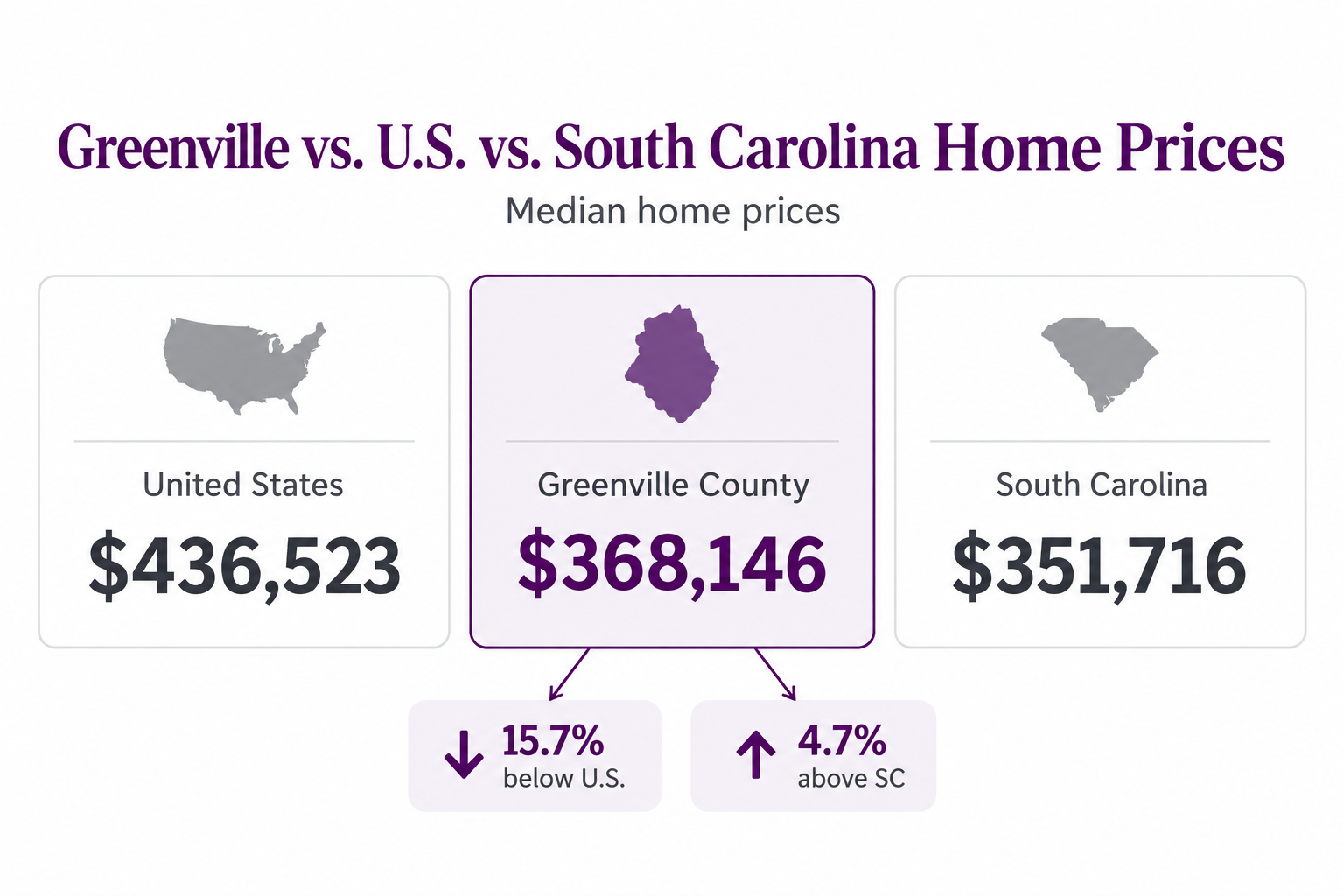
Median sale prices, Redfin data for May 2026.
At $368,146, the median Greenville County home runs roughly 15.7% below the national median of $436,523. On a percentage basis that is a serious discount. In dollars it is about $68,000 of purchase price, which at current rates is a few hundred dollars a month of payment you simply never make.
Against the places most of our relocation clients are leaving, the gap widens considerably. Greenville runs roughly 29% cheaper than New York City. Atlanta, which people often assume is the affordable Southern option, runs about 10% higher overall than Greenville does.
Worth being honest about: Greenville is about 4.7% above the South Carolina median of $351,716. If you are moving here from out of state, you are getting a discount against the country. If you are moving here from elsewhere in South Carolina, you are probably paying more, not less. Greenville is the expensive part of an inexpensive state.
What will you actually pay in property taxes?
This is the single most misunderstood cost for out-of-state buyers, and getting it wrong is expensive in a way most people do not see coming.
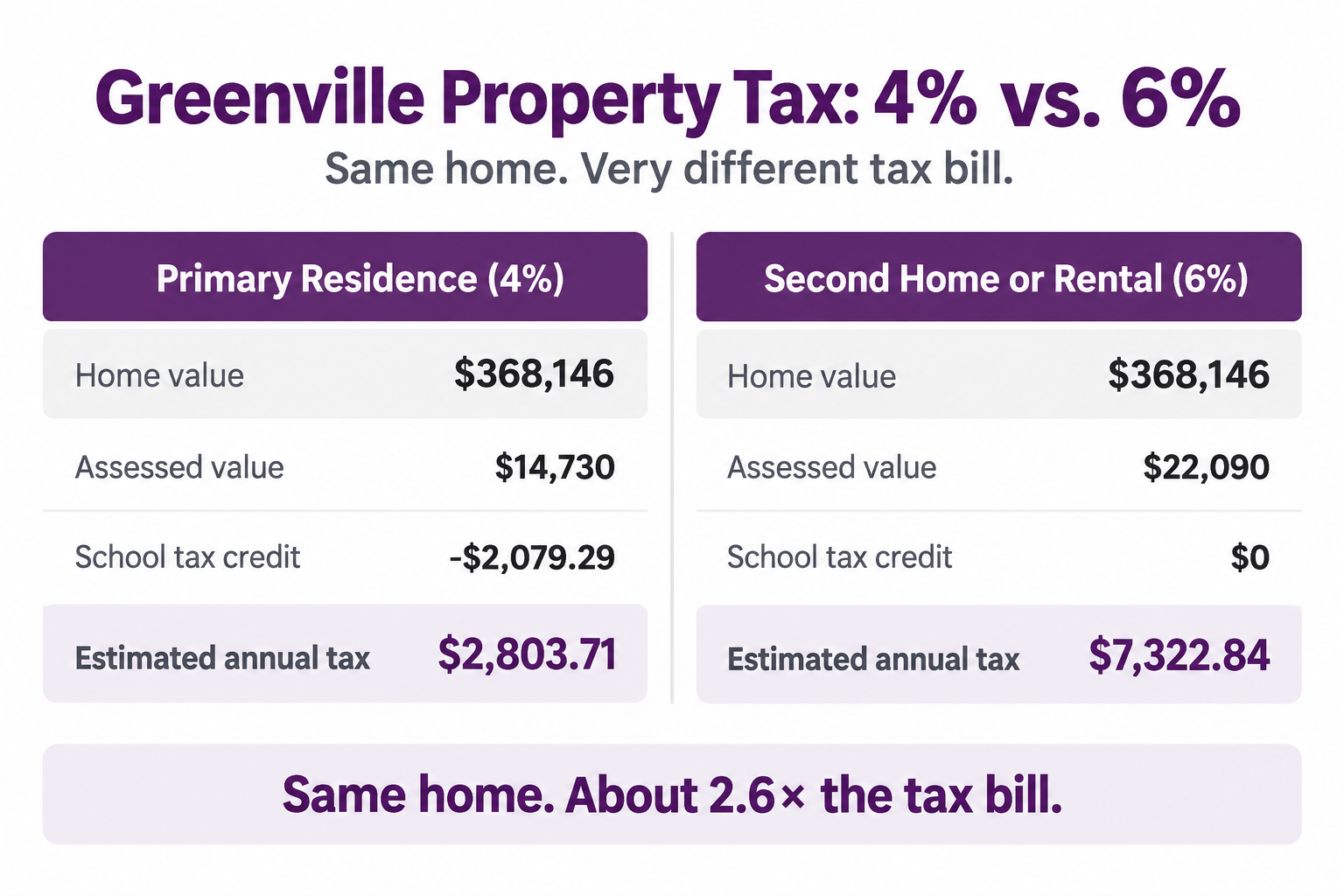
Inside Greenville city limits, tax district 500, 2025 tax year, from the Greenville County Real Property Tax Estimator. Outside the city the gap is closer to 3 times. Full breakdown for both districts below.
South Carolina assesses owner-occupied primary residences at 4% of fair market value. Everything else, meaning second homes, rentals, and investment property, is assessed at 6%. Same house, same street, same millage.
Most explanations stop at the assessment ratio. That is only half of what is happening, and the half they leave out is the bigger one.
The other half is the school operations tax credit. Owner-occupied primary residences receive it. Properties assessed at 6% do not get it at all. So the bill moves twice: a larger assessed value, and the total loss of a credit worth more than two thousand dollars on a median-priced home.
This is not a local courtesy or a county policy that could quietly change. It is state law. South Carolina Code Section 12-37-220(B)(47), created by Act 388 of 2006, exempts owner-occupied residential property receiving the 4% ratio from all property taxes imposed for school operating purposes. Worth knowing the limit of it: the exemption does not cover millage levied to repay school general obligation debt, which is why your bill still carries some school-related tax rather than dropping to nothing.
On the median-priced home inside Greenville city limits, that works out to about $2,804 a year as your primary residence against $7,323 as a second home or rental. The assessed value climbs by a predictable amount, but the credit line does the real damage. The 6% property does not get a reduced credit. It gets none at all.
City limits or outside them? It moves the number again.
Greenville city properties carry a city levy on top of the county levy. Buy the identical home outside the city limits and the bill drops. Here is the same $368,146 home in two districts.
| Same $368,146 home | City of Greenville | Outside city limits |
|---|---|---|
| As your primary residence (4%) | $2,803.71 | $2,139.38 |
| As a second home or rental (6%) | $7,322.84 | $6,326.58 |
| How much more the 6% bill runs | 2.6 times | 3.0 times |
Calculated with the Greenville County Real Property Tax Estimator, 2025 tax year. City figures use district 500, Greenville City. Outside-city figures use district 005. There are many districts across the county, so run your own address before budgeting.
So depending on where you land, the same house costs roughly two and a half to three times more in annual tax if it is not your primary residence. And the city versus county line alone is worth about $665 a year on a median-priced primary residence.
I have watched buyers budget for a $2,800 tax bill and open a $7,300 one, because nobody told them the credit does not follow the house. It follows the paperwork. Victor Amadi, Broker-in-Charge, PRODUCER Realty
Do not skip this step: the 4% rate is not automatic. You have to file for legal residence with the Greenville County Assessor after closing. Buyers who assume the rate transfers with the property get the 6% bill and the lost credit. Confirm the current filing deadline and form with the Assessor's office directly, because requirements do get updated.
Compared against the national median effective property tax rate of roughly 1.02%, which would put this same home near $3,755 a year, a Greenville primary residence saves you about $950 a year inside the city and about $1,600 outside it. Over a ten year hold that is somewhere between $9,500 and $16,000 you keep. The comparison sets specific districts against a national average, so treat it as directional, but the direction is firmly in your favor.
Not sure which tax district your target neighborhood falls in?
Millage varies across the county, and the difference between two neighborhoods you are considering can be several hundred dollars a year. Send me the addresses and I will run the actual numbers before you write an offer.
What income do you need to live comfortably here?
Here is the arithmetic on the median home, so you can adjust it to your own situation rather than trusting a round number from a national listicle.
Start with $368,146 and put 20% down. That leaves a loan near $294,500. At a 6.5% thirty year fixed rate, principal and interest run about $1,861 a month. Add property taxes at the owner-occupied rate, which is roughly $234 a month in the city and $178 outside it. Add homeowner's insurance on top of that.
Using the conventional guideline that housing should stay near 28% of gross income, you land somewhere around $96,000 in household income to carry the median home inside the city, and closer to $94,000 outside it, without housing dominating your budget.
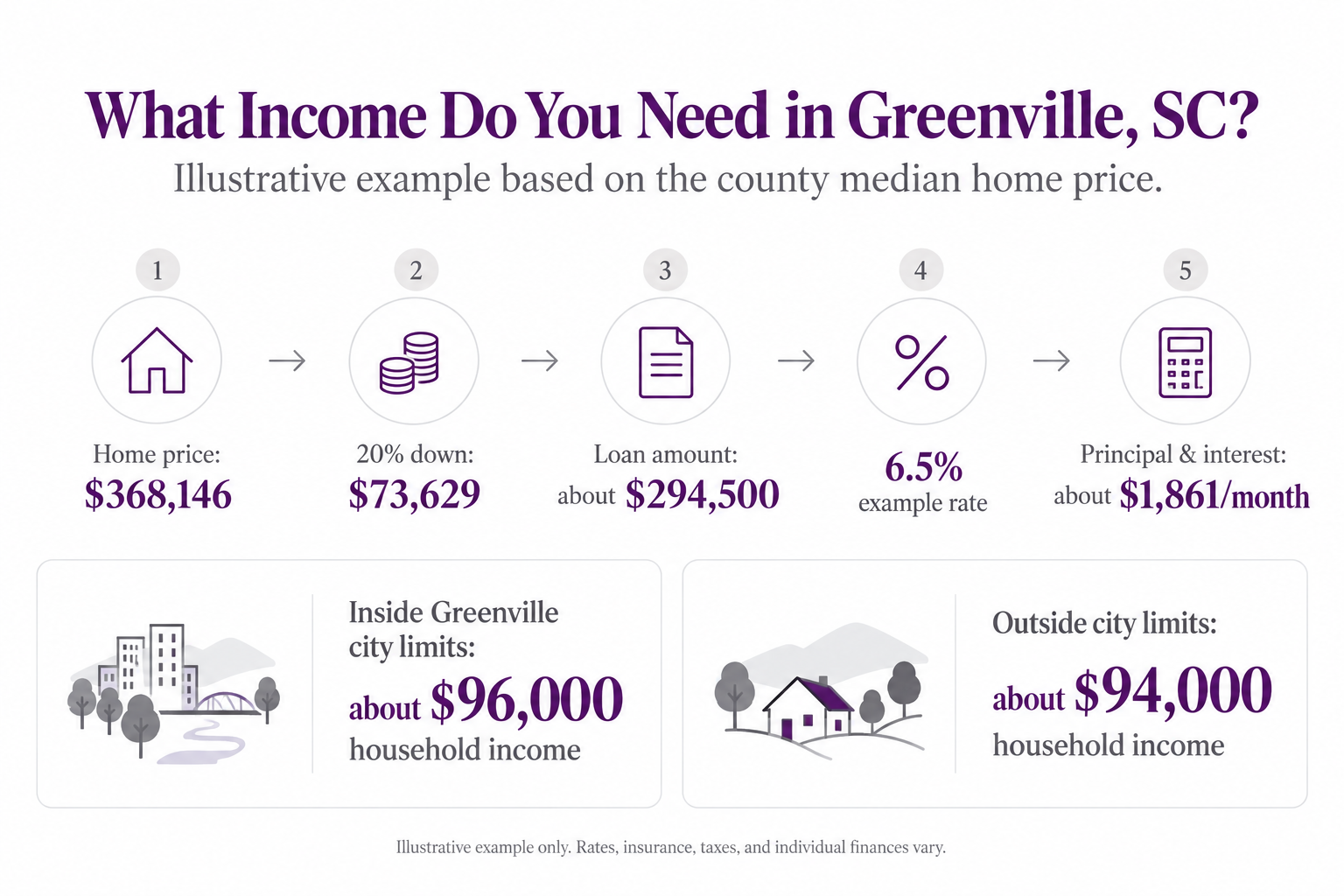
Illustrative example at an assumed 6.5% rate with 20% down. Your rate, insurance, and taxes will change the result.
Two honest caveats. Mortgage rates move, and that 6.5% assumption drives the whole calculation, so run your own number against a current quote. And 20% down is a large assumption. Less down means a bigger loan and mortgage insurance, which pushes the required income up.
Can you do better just outside Greenville?
Usually, yes. This is the part of the conversation that most national cost of living articles miss entirely, because they treat Greenville as a dot on a map rather than the center of a metro.
The county median is pulled upward by the city itself and by the neighborhoods closest to downtown. Move outward and the same square footage costs less, often meaningfully less, while you keep access to the same employers, the same airport, and the same mountains.
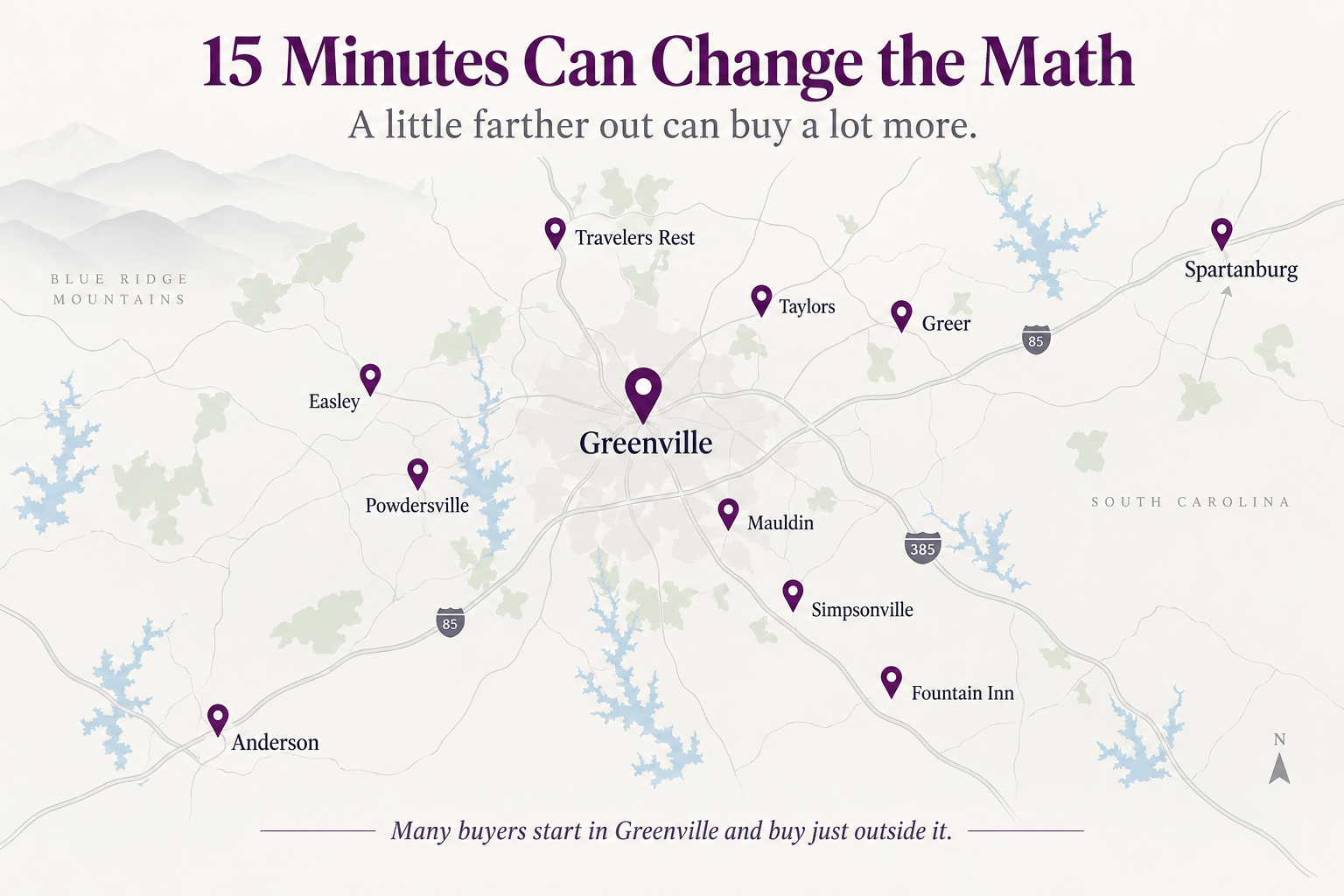
Illustrative map, not to scale. Towns like Mauldin and Taylors sit close to Greenville, while Anderson and Spartanburg are separate markets farther out.
Places worth putting on your list depending on what you are optimizing for:
- Easley and Powdersville tend to offer more house per dollar while staying a straightforward commute into Greenville.
- Simpsonville, Mauldin, and Fountain Inn sit along the southern corridor, with newer construction and larger lots across a range of price points.
- Greer and Taylors put you near the BMW and automotive corridor and closer to the airport.
- Anderson and Spartanburg are separate markets entirely and generally price below Greenville County, though you are trading commute time for it.
- Travelers Rest is the exception. Proximity to the Swamp Rabbit Trail and the mountains has pushed it up, so do not assume smaller means cheaper here.
A lot of the families I work with land somewhere they had never heard of when they started looking. They came in searching Greenville and bought in Simpsonville, Easley, or another area outside of Greenville, because the same budget bought a different life fifteen minutes out. Victor Amadi, Broker-in-Charge, PRODUCER Realty
What costs surprise people who move here?
You will need a car, and probably two. Greenville's downtown is genuinely walkable and the Swamp Rabbit Trail is a real asset, but the metro is not built around transit. If you are arriving from a city where you sold the car and used the subway, budget for two vehicles, two insurance policies, and the fuel to go with them. For many relocating households this is the largest unbudgeted line item.
Cooling costs, not heating costs. Upstate summers are long and humid. Households moving down from the Northeast often plan for a mild winter, which they get, and underestimate a July electric bill running air conditioning around the clock.
HOA dues, and they are usually annual here. This trips up buyers from markets where every association bills monthly. Around the Upstate, most single-family neighborhoods charge an annual HOA fee, often paid in one lump at the start of the year. Townhomes and condos are typically monthly, and a minority of single-family communities are too, usually where the association maintains more amenities. Ask which structure applies before you build a monthly budget around it, because an annual bill you forgot about is a rough January.
Insurance is not the Florida coast, but it is not nothing. The Upstate sits well away from hurricane exposure, which helps considerably compared with the South Carolina coast. Get an actual quote on the specific property before you commit to a budget.
Is Greenville still affordable, or did that window close?
Both, depending on where you are standing.
The median sale price rose about 25% over five years, from $294,500 in May 2021 to $368,146 in May 2026. That is roughly $73,600 added to the median home in half a decade. Anyone who tells you Greenville is an undiscovered secret has not looked at that curve.
Compared with the national picture, the value case still holds clearly. Compared with Greenville five years ago, it does not. Both things are true, and which one matters depends entirely on whether you are moving here from Ohio or already own here.
For retirees the math tilts further in your favor, though not by as much as it is usually described. South Carolina offers a retirement income deduction of up to $3,000 for those under 65 and up to $10,000 at 65 or older. There is a separate $15,000 deduction at 65, but any retirement deduction you claim is subtracted from that figure rather than added to it, so $15,000 per person is the combined ceiling on the two rather than the starting point. On the property tax side, a homestead exemption covers $50,000 of fair market value once you are 65 and have been a South Carolina resident for a full calendar year. We work through all of it in the guide to retiring in Greenville.
Where does the money come from? The job market side
Cost of living only means something against income. Greenville's employment base is broader than most cities its size, anchored by Prisma Health, Greenville County Schools, Michelin North America, Bon Secours St. Francis, and Duke Energy, alongside GE and the automotive corridor running toward Spartanburg.
That mix matters for affordability because it is not one industry. Healthcare, education, advanced manufacturing, and energy do not usually contract at the same time, which has kept the local housing market steadier through cycles than single-employer metros.
Frequently asked questions
Is Greenville, SC expensive compared to the rest of the country?
No. The median home runs about 15.7% below the national median, and South Carolina's overall cost index sits near 95 against a national 100. Housing is where the gap is widest.
Is Greenville expensive compared to the rest of South Carolina?
Yes. At $368,146 the county median sits about 4.7% above the state median of $351,716. Greenville is the costlier end of an inexpensive state, and surrounding Upstate towns like Easley, Anderson, and Spartanburg generally price below it.
What are property taxes on the median Greenville home?
About $2,804 a year inside Greenville city limits and about $2,139 outside them, as your primary residence at the 4% assessment ratio, using the county estimator for the 2025 tax year. The identical home as a second home or rental at 6% runs about $7,323 in the city and $6,327 outside it, because it loses the school operations tax credit as well as carrying the higher assessment. Millage varies across districts, so check your specific address.
Why is the 6% property tax bill so much higher than the 4% one?
Two effects stack. On a $368,146 home the assessed value rises from $14,730 to $22,090, and the property also forfeits the school operations tax credit, worth $2,079 in this example. Most explanations account for the assessed value only and miss the credit entirely, which is why the real gap is far wider than people expect. The result runs roughly two and a half to three times the annual bill depending on the district. The credit comes from South Carolina Code Section 12-37-220(B)(47), enacted by Act 388 of 2006, and it applies only to owner-occupied primary residences.
Is it cheaper to buy outside Greenville city limits?
On property taxes, yes. City properties carry a city levy on top of the county levy. On a median-priced primary residence that difference is roughly $665 a year. Purchase prices outside the city are often lower as well, though that varies considerably by town.
Do I have to apply for the 4% property tax rate?
Yes. Legal residence status is not automatic on purchase. You file with the Greenville County Assessor, and missing it means the 6% rate and no school tax credit. Confirm the current deadline with the Assessor directly.
What salary do you need to live in Greenville, SC?
To buy the median home at 20% down and a 6.5% rate while keeping housing near 28% of gross income, roughly $96,000 inside the city and about $94,000 outside it. Buying in Easley, Anderson, or Spartanburg, or buying below the county median, lowers that figure further.
Are HOA fees monthly in Greenville?
Usually not for single-family homes. Most Upstate single-family neighborhoods bill an annual HOA fee. Townhomes and condos are typically monthly. Always confirm the structure before budgeting.
Has Greenville gotten too expensive to move to?
Not against the national market, where the value gap is still substantial. Against Greenville in 2021, prices are up roughly 25%, so the easy window has closed. Looking just outside the city reopens a lot of it.
Let's put real numbers against your actual move.
Every relocation budget breaks somewhere different, and it is rarely the mortgage. I have walked several hundred families through this, including which towns outside Greenville stretch a budget furthest and which tax districts quietly cost more. Bring me your price range and your commute, and I will tell you where it actually works.
| Schedule a relocation strategy call |
Cost figures reflect Redfin data for May 2026. Property tax figures were calculated with the Greenville County Real Property Tax Estimator for the 2025 tax year, using district 500 for city figures and district 005 for outside-city figures, and are estimates only. Millage rates, credits, and state tax provisions change. Verify anything you plan to budget against with the Greenville County Assessor or a tax professional.
