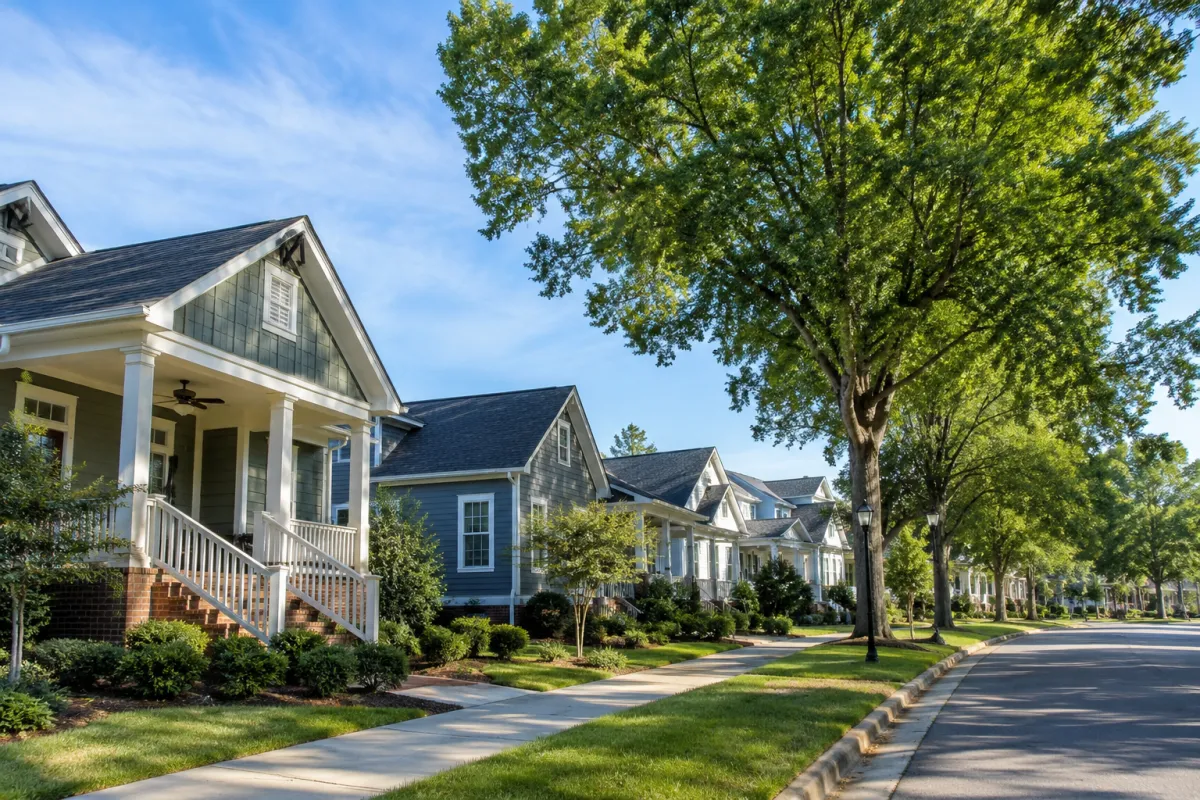
Is Greenville, SC a Good Place to Live? 2026 Guide
Yes, for most people moving here from out of state, Greenville is a genuinely good place to live. You get a walkable downtown that actually works, a median home price roughly $68,000 below the national median, no state tax on Social Security income, and the Blue Ridge foothills forty minutes from your driveway. The tradeoffs are real: August humidity that has to be experienced to be understood, almost no usable public transit, and a housing market that has climbed about 25 percent in five years.
Get My Free Greenville Relocation Guide →
Prefer to talk it through first? Call or text 864-438-5050, or send a message via our contact form — I personally respond to every relocation inquiry.
I have sold real estate in the Upstate for over twenty years and closed more than 500 transactions here. Most of what follows is what I tell clients on the phone before they ever book a flight.

Who Greenville is a great fit for, and who it is not
I would rather lose a client than move someone here who will be unhappy. So let me start with the honest sorting.
Greenville works well for you if:
You are moving from a high-cost metro and want your housing dollar to go further without giving up a real downtown
You work in advanced manufacturing, engineering, healthcare, automotive, or you are fully remote
You want mountains, lakes, and trails as part of ordinary weekly life rather than a vacation
You are retiring and the state tax treatment of retirement income matters to your math
You want a mid-size city where you will actually run into people you know
Greenville is probably not your city if:
You need frequent nonstop flights to a lot of destinations. GSP is convenient and pleasant, but it is not a hub
You want to live without a car
You work in a field with a thin local market here, such as investment banking, entertainment, or venture-backed startups
You cannot tolerate humidity. This is the number one reason people leave, and it is not close
You want a large, deeply established community of your specific cultural or religious background. Greenville is diversifying, but it is still a mid-size Southern city
What does it cost to live in Greenville, SC?
Cost of living here runs below the national average, though the gap has narrowed considerably since 2020. South Carolina's overall cost of living index sits near 95 against a national baseline of 100, and Greenville tracks close to the state figure.
Housing is where the advantage is clearest. As of May 2026, Redfin put the median home sale price in Greenville County at $368,146, up 0.4 percent from a year earlier. The national median that same month was $436,523, and the South Carolina median was $351,716. So Greenville County sits slightly above the state number and well below the national one.
Compared against specific metros, the difference is sharper. Greenville is roughly 29 percent less expensive than New York City excluding rent, with rent running about 65 percent lower, according to Numbeo's May 2026 data. Atlanta runs about 10 percent higher overall.
Where the savings actually show up: housing, property taxes, and restaurant prices. Where they do not: groceries, car insurance, and utilities in summer. Your July power bill will surprise you.
The honest caveat. Greenville County's median sale price has risen roughly 25 percent over five years, from $294,500 in May 2021. If you are moving from San Francisco or Boston, this still feels like a bargain. If you are moving from Columbia or Spartanburg, it will not.
We put real 2026 numbers on all of this in our full cost of living breakdown.

What are property taxes like in Greenville?
This is where I save relocating clients the most money, and it is the single most valuable thing in this article.
South Carolina assesses property at a ratio, not at full market value. Owner-occupied primary residences are assessed at 4 percent of fair market value. Everything else, including second homes and rentals, is assessed at 6 percent. Greenville's median effective property tax rate lands around 0.83 percent, compared with a national median near 1.02 percent.
Thanks to the school operating tax credit that applies to owner-occupied homes, a homeowner taxed at the 4% legal residence rate often pays roughly two to three times less in property tax than an identical home taxed at the 6% rate.
Here is the trap. When you close on a home in South Carolina, the county does not know it is your primary residence. You are assigned the 6 percent rate by default. You have to apply for the legal residence 4 percent rate with the county assessor, and the application deadline is January 15. Miss it, and you pay the higher rate for a full year with no retroactive fix. On a $400,000 home that mistake can run into the thousands.
Every out-of-state buyer I work with gets a reminder about this at closing and again in December. Nobody tells you at the closing table.
Retirees should also know about the homestead exemption: homeowners who are 65 or older, legally blind, or permanently disabled can exempt $50,000 of fair market value. I think this should be higher because home prices are much higher than they were when this amount was enacted into law in 1972.

Where should you live in Greenville?
The honest answer is that "Greenville" means four or five different lifestyles depending on where you land. Once you have a neighborhood in mind, browse active Greenville-area listings to see what is currently on the market.
Downtown and the West End. Walkable, expensive per square foot, small yards or none. You are buying proximity rather than space, with Main Street, Falls Park, and Fluor Field within a walk. If you want a condo in Downtown Greenville, be ready to spend some big money because Downtown Greenville has some of the most expensive properties in the Upstate area, and some of them are well over three million dollars.
The Augusta Road and Cleveland Park area. Established, mature trees, strong resale, tight inventory. This is where a lot of move-up buyers end up and stay, and it is close to Downtown Greenville
Simpsonville and Five Forks. Newer construction, larger lots, and more square footage per dollar than anywhere closer in. The tradeoff is a real commute. Newer construction, more house for the money, and a real commute tradeoff.
Greer and Taylors. Between downtown and GSP airport. Good value, strong access to the BMW and Michelin employment corridor.
Travelers Rest. North, closer to the mountains, connected to downtown by the Swamp Rabbit Trail. Small-town feel with a food scene that punches above its size.
For a breakdown by housing stock, commute and price tier, see our guide to the best neighborhoods in Greenville.
Are the schools good in Greenville?
Greenville County Schools is the largest district in South Carolina, and that scale is the key thing to understand. Asking whether Greenville County Schools is good is like asking whether a state is good. The answer varies enormously by attendance zone.
There are excellent public schools here. There are also schools I would not choose for my own family. The zone matters far more than the district, and zone lines shift as the county grows.
The mistake I see constantly: buyers rely on a school rating shown on a listing portal, which is often out of date, and they never verify the actual attendance zone with the district. Verify it directly. Do not take the listing's word for it, and do not take mine.
Private school is a real option here with a deep bench of established schools, but budget accordingly. Some of the private schools can cost tens of thousands of dollars a year for tuition.
Attendance zones are the part people get wrong. We explain how Greenville County attendance zones actually work, including why listing data is often inaccurate.

What is the job market like?
Greenville's economy was built on textiles, collapsed with them, and rebuilt around advanced manufacturing. That history explains the shape of the job market today.
The largest employers include Prisma Health, Greenville County Schools, Michelin North America, Bon Secours St. Francis Health System, and Duke Energy, with GE and the broader automotive corridor anchoring the manufacturing side. Healthcare, advanced manufacturing, engineering, and professional services are the dominant sectors.
Be realistic about wages. Salaries here generally run below what the same role pays in a major metro. Someone relocating from Washington, DC can expect roughly 16 percent lower pay for a comparable position, though the cost of living difference more than absorbs it for most households. If you are moving on a remote salary anchored to a coastal market, you are in the best possible position.
Where the market is thin: finance, media, biotech, and venture-backed technology. There are good jobs in all of these here, but there are not many of them, and if yours ends, you may be looking at a relocation rather than a job change.
“An out of state move has several implications on a lot of different levels, and PRODUCER Realty has been there every step of the way walking us through all the hurdles.” - Melissa W.

What is the commute like?
Manageable by big-city standards, worsening by local standards. Most of my clients commute 15 to 30 minutes. The pinch points are I-385 into downtown in the morning, I-85 through the Greer corridor, Wade Hampton Boulevard, Laurens Road, and Woodruff Road, which is a genuine local punchline and a real quality of life issue.
A location that looks close on a map may involve a longer commute than expected at certain times of day. Before choosing a home, test the drive between the property and the places you will visit regularly, including: work, school, childcare, medical appointments, shopping, family, and recreation. Commute patterns may be just as important as mileage.
Public transit exists but is not a practical commute option for most people. Plan on a car per working adult. Downtown residents may be able to walk or bike to some daily destinations. In most suburban and rural areas, however, driving is necessary for work, shopping, appointments, and entertainment.
Greenville may not be the best fit for someone who wants to live completely car-free unless that person selects a location and lifestyle carefully.
We published real drive times, town by town, off-peak and at rush hour, in our Greenville commute times guide.
What is the weather actually like?
Four real seasons, which surprises people who expect Florida.
Spring is the best argument for the entire region: long, green, and full of dogwoods. Fall is nearly as good and runs late, often into November. Winters are mild with a handful of freezes, occasional ice, and snow that shuts the county down once every year or two because there is no reason to own the equipment for more.
Summer is the honest problem. June through September is hot and humid in a way that changes how you plan your day. You go outside early or late, not in the middle. Pollen season in spring is also genuinely severe, and it is the second most common complaint I hear from transplants after the humidity. For allergy sufferers like me, pollen season can be a little uncomfortable.
Is Greenville safe?
Greenville is broadly comparable to similar mid-size Southern metros, which means the metro-level number is not very useful to you. Safety varies by area, and the areas vary block by block in some parts of the county.
I do not give clients a blanket answer on this. I tell them to look at the specific neighborhood, drive it at different times of day, and talk to people who live there.
The downsides of living in Greenville
Every relocation guide skips this part. Here are the six things I actually tell people.
1. The humidity is not a joke. Four months a year, going outside at 2pm is unpleasant. This is the leading reason people move away.
2. You will drive everywhere. Downtown is walkable. The rest of the county is not, and transit will not solve it for you.
3. Growth is outpacing infrastructure. Roads, schools, and water systems are catching up to a population that has expanded fast. Woodruff Road is the symbol of this, but it is not the only place you will feel it.
4. Prices have moved. The Greenville that was a screaming bargain in 2015 does not exist anymore. It is good value. It is not cheap.
5. The airport is convenient but limited. GSP is a genuinely pleasant airport with easy parking. It also has limited nonstops, and you will connect through Charlotte or Atlanta more often than you would like.
6. Cultural depth is mid-size city depth. The food and arts scene has grown remarkably in fifteen years. It is still not Atlanta or Nashville, and pretending otherwise sets people up for disappointment.
None of these have stopped the county from growing. But you should know them before you sign anything.

Is Greenville good for retirees?
For a lot of retirees, the tax math here is the whole argument. South Carolina does not tax Social Security income, offers a substantial retirement income deduction, and the 4 percent owner-occupied assessment plus the $50,000 homestead exemption for those 65 and older brings property tax bills well below what most retirees are used to.
According to the SC Department of Revenue, South Carolina also provides a retirement income deduction of up to $3,000 for individuals under age 65 and up to $10,000 for those age 65 or older. Once an individual reaches 65 years old, a separate $15,000 deduction can be claimed against any South Carolina income.
Add Prisma Health and Bon Secours for healthcare access, a mild winter, and mountains within an hour, and the appeal is straightforward.
The caveats: summer humidity is harder as you age, and if you want a walkable retirement, you are limited to a fairly small and fairly expensive part of the county.
The tax picture is more specific than most summaries suggest. Full detail in our guide to retiring in Greenville.
Thinking about moving here? Start with this
If Greenville is on your list, do these four things in order.
Visit in July or August. Not April. Anyone can love Greenville in April. If you still like it in August, you will be fine.
Pick the commute before the house. Drive from three candidate areas to your actual workplace at 8am on a weekday. This decision constrains everything else.
Verify the school attendance zone directly with the district if you have children, before you write an offer.
Calendar the January 15 legal residence filing the day you go under contract.
My step-by-step Greenville & Upstate South Carolina relocation guide covers timelines, movers, utilities, and what to handle before versus after you arrive.
Once you’ve decided, work through our relocation checklist and first 45 days, which covers the SCDMV deadlines and the filing that saves you thousands.
Frequently asked questions
Is Greenville, SC expensive to live in? No, it runs below the national average, with housing the biggest source of savings. Greenville County's median home sale price was $368,146 in May 2026 versus a national median of $436,523. Groceries, utilities, and car insurance are closer to national norms, so the overall savings are smaller than the housing gap alone suggests.
Is Greenville, SC a good place to raise a family? Generally yes. Parks, youth sports, and outdoor access are strong, and family-oriented areas like Simpsonville, Five Forks, and Greer have grown around exactly this demographic. The critical variable is the school attendance zone, which you should verify with the district before buying rather than relying on listing site ratings.
What are property taxes in Greenville County? Owner-occupied primary residences are assessed at 4 percent of fair market value, everything else at 6 percent. The median effective rate is around 0.83 percent, below the national median near 1.02 percent. You must apply for the 4 percent legal residence rate with the county assessor by January 15 or you will be billed at 6 percent for the year.
Does it snow in Greenville, SC? Rarely, and rarely much. A measurable snow happens roughly once every year or two and typically closes schools and roads for a day or so, because the county does not maintain a large snow fleet. Ice is the more common winter hazard.
How far is Greenville from the mountains and the beach? Roughly 40 minutes to the Blue Ridge foothills and Table Rock, about an hour to Asheville, and about four hours to Charleston or Myrtle Beach. The mountain access is the daily benefit. The coast is a long weekend.
Do you need a car in Greenville, SC? For nearly everyone, yes. Downtown and parts of the West End are genuinely walkable, but public transit is limited and most employment, shopping, and schools are spread across the county.
Is Greenville, SC growing too fast? That depends who you ask, and it is a live local debate. Population growth has outpaced road, school, and water infrastructure in several parts of the county, which residents feel most acutely in traffic and school crowding. It is also why home values have held up.
What is the average salary in Greenville, SC? Wages generally run below major metro levels for equivalent roles. Someone relocating from a high-cost metro should expect a pay reduction that is usually more than offset by lower housing and tax costs, particularly if they own rather than rent.
Is Greenville better than Charlotte or Asheville? Different tradeoffs. Charlotte offers a deeper job market and a real airline hub, at higher cost and with more traffic. Asheville has more dramatic mountain access and a distinctive culture, with a considerably tighter and pricier housing market. Greenville sits between them on cost, jobs, and pace.
What is the downside of moving to South Carolina? Summer humidity, car dependence, and infrastructure that is catching up to population growth. Wages also tend to run below national norms, which matters more for people taking a local job than for remote workers or retirees.
Ready to make your move?
Get My Free Greenville & Upstate SC Relocation Guide →
If you are weighing a move to Greenville or the Upstate, do not try to figure this out alone from a spreadsheet. Call or text me directly at 864-438-5050, or send a message through our contact form, and I will personally walk you through your timeline, budget, and the neighborhoods that fit your life best.
About the author
Victor Amadi is the founder and Broker-in-Charge of PRODUCER Realty, serving home buyers, sellers, relocation clients, and new construction buyers throughout Greater Greenville and Upstate South Carolina. He holds the CHSA and CDPE designations, has worked this market for more than twenty years, and has helped clients complete more than 500 real estate transactions. His work focuses on local housing-market guidance, strategic home selling, relocation, move-up purchases, and new construction.
