
Moving to Greenville, SC: Your Relocation Checklist and First 45 Days
The hard part of moving to Greenville is not finding the house. It is the forty five day clock that starts the day you arrive, and the bill that comes with bringing your cars. South Carolina charges roughly $305 per vehicle just to bring one into the state, and you cannot register it until you have paid county property tax on it. Most people budget for movers and a mortgage. Almost nobody budgets for that.
Your first 45 days, in order
1. Get South Carolina auto insurance.
2. Get a vehicle tax bill from the County Auditor, then pay it at the Treasurer and keep the original receipt.
3. Register the vehicle at SCDMV, paid tax receipt in hand.
4. Get your South Carolina driver's license.
5. File for legal residence on your home, which is the step that sets your property tax rate.
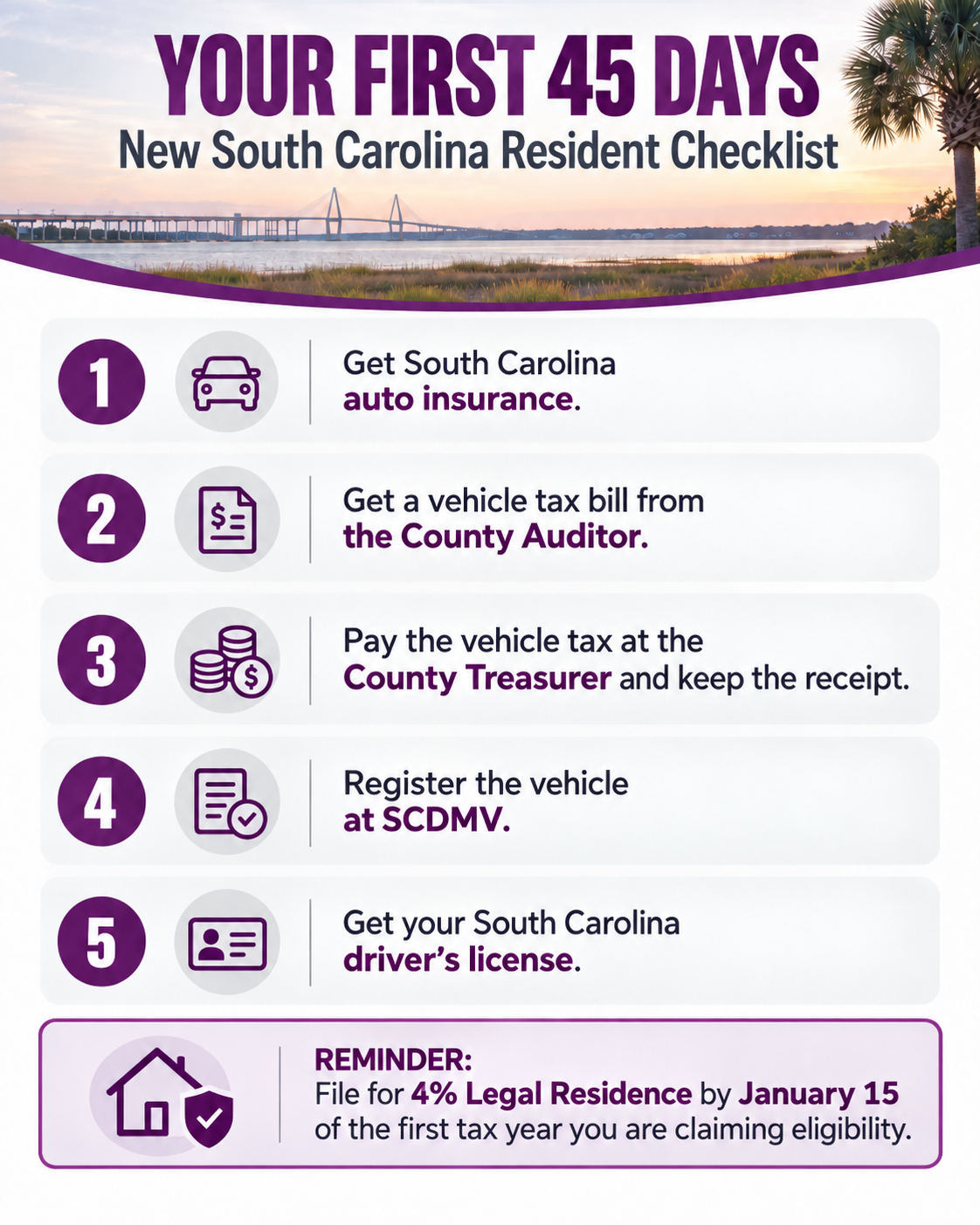
Deadlines per the SCDMV and the Greenville County Assessor. Confirm current requirements before relying on them.
This is the practical companion to our guide on whether Greenville, SC is a good place to live. That one helps you decide. This one is what happens after you have decided.
The forty five day clock
South Carolina gives new residents forty five days. The SCDMV states it plainly: you must apply for a South Carolina driver's license "within 45 days of moving to the state", and you have "45 days to transfer your vehicle registration to this state".
That sounds like plenty of time. It is not, because the vehicle steps have to happen in a specific order, and two of them involve county offices that are not the DMV.
| What | Deadline from arrival |
|---|---|
| South Carolina driver's license | 45 days |
| Vehicle registration transfer | 45 days |
| Legal residence filing for the 4% property tax rate | January 15, hand delivered or postmarked |
Deadlines per the SCDMV moving to South Carolina page. Confirm current requirements before you rely on them.
What it actually costs to bring your cars
This is the line item that catches nearly every out-of-state buyer, and it is worth knowing before you load the truck.
The SCDMV charges a one time fee structure when a vehicle enters the state:
| Per vehicle, entering South Carolina | Amount |
|---|---|
| Infrastructure Maintenance Fee | $250 |
| Title fee | $15 |
| Registration and license plate | $40 |
| Total per passenger vehicle | $305 |
Per the SCDMV moving to South Carolina vehicle page. Vehicles with a higher gross vehicle weight may pay more.
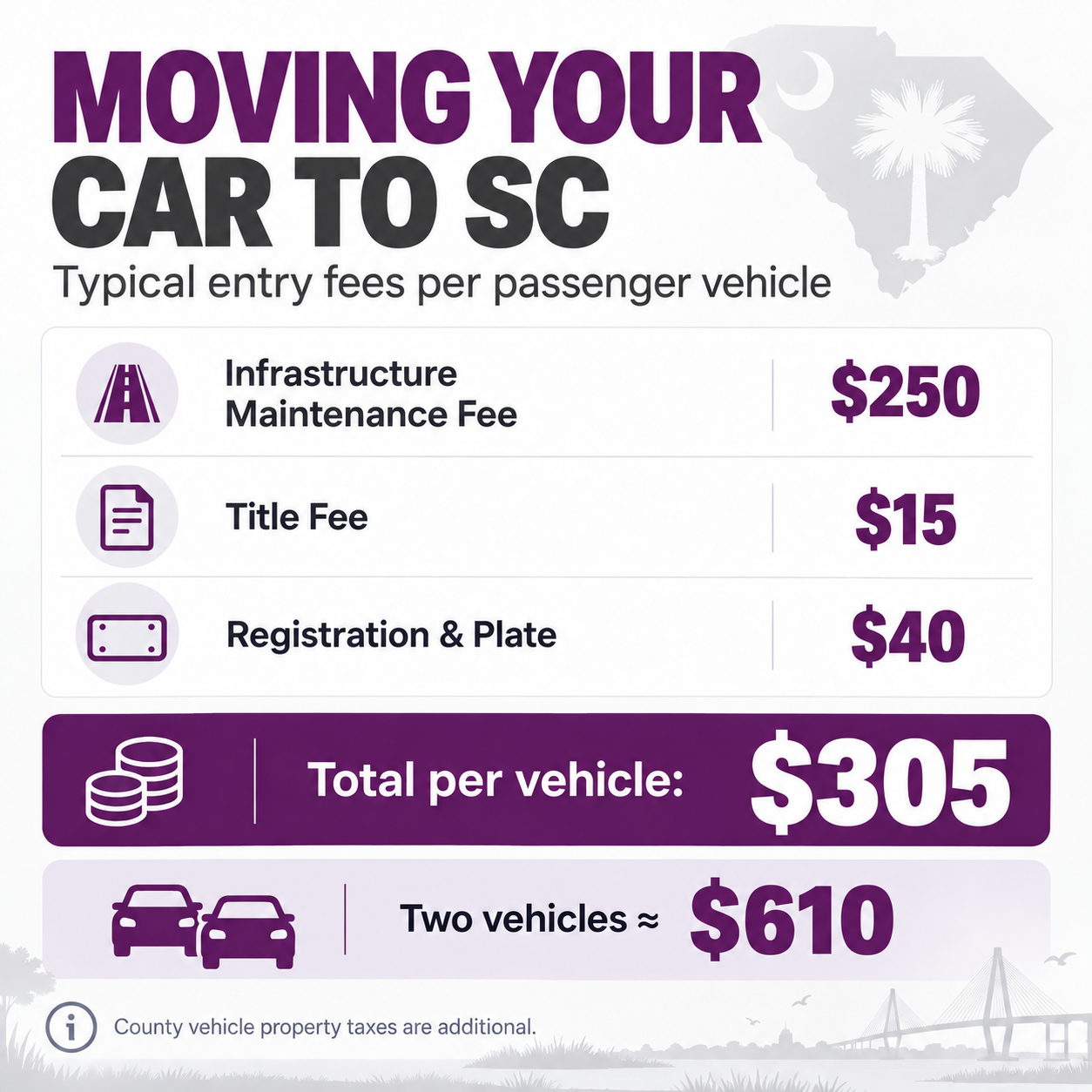
Entry fees only. The annual county property tax on each vehicle is separate and is paid twelve months in advance.
Two cars means roughly $610 before you have paid a cent of property tax. And since Greenville is a two car metro for most households, that is the realistic case rather than the worst case.
South Carolina taxes vehicles every year. If you are coming from a state that does not, this is the surprise. Greenville County states it directly: "Before registering a vehicle in South Carolina, you must pay personal property tax on your vehicle." And the county notes that vehicle taxes are paid twelve months in advance. So a new arrival pays a full year up front, per vehicle, on top of the $305.
The vehicle sequence, which trips people up
You cannot simply go to the DMV. The order matters, and getting it wrong means a wasted trip.
- Insurance first. The vehicle has to be insured in South Carolina by a carrier licensed to do business here. Often this is just updating your address with your existing insurer, but confirm they are licensed in the state.
- Then the County Auditor, to get a vehicle tax bill. Bring the vehicle paperwork, meaning the title, certificate of origin, registration, or bill of sale, plus proof that you live in the county.
- Then the County Treasurer, to pay that bill. Keep the original paid receipt. The DMV will want it, and a photocopy is not the same thing.
- Then SCDMV. You will need a completed Title Application, your out-of-state title or registration, valid identification, liability insurance information, that original paid tax receipt, and the fees.
The Greenville County Auditor's office handles the tax bill side. If you are buying in Easley or Powdersville you are in Pickens County, and in Anderson or Spartanburg you are dealing with those counties instead. Same sequence, different office.

Keep the original paid tax receipt with your vehicle paperwork. The DMV will ask for it, and a photocopy is not the same thing.
People budget for the movers and the down payment. Then they get here and find out the cars cost six hundred dollars to bring and the state taxes them every year. It is not a huge number in the scheme of a move, but it is a lot more pleasant to know about in advance. Victor Amadi, Broker-in-Charge, PRODUCER Realty
The one filing that saves you the most money
Once you own the home and live in it, file for legal residence with the County Assessor. This is the step that moves your property from the 6% assessment ratio to 4%, and it also unlocks a school operations tax credit.
It is not automatic, it does not come with the house, and missing it is genuinely expensive. On a median priced Greenville home the difference runs to thousands of dollars a year.
Greenville County sets the deadline at January 15, and the application can be hand delivered or postmarked by that date. Two details worth knowing: the county states that applications missing information or documents will not be processed, so a form submitted on time but incomplete does not protect you. And you must still be domiciled at the residence when you file.
One point of confusion worth clearing up. The homestead exemption, which is a separate benefit for homeowners who are 65 or older, legally blind, or permanently disabled, does carry a minimum South Carolina residency requirement. The legal residence 4% filing does not. A brand new arrival can file for it as soon as they own and occupy the home.
We walk through exactly what that costs, with real county estimator figures for both ratios and for inside versus outside the city limits, in the cost of living guide. If you read one other thing before closing, make it that.
Planning a move and want the real cost picture?
Tell me where you are moving from, how many vehicles you are bringing, and the price range you are considering. I will put together what the first ninety days actually costs, not just the mortgage.
Before you move: the scouting trip
If you can manage one trip before you commit, use it properly. Most people spend it looking at houses, which is the least useful thing they could do with it, because houses photograph well and you can see fifty of them online.
What you cannot do online:
- Drive the commute on a weekday morning. Not Saturday afternoon. Tuesday at eight, in the direction you will actually be going. This single exercise prevents more regret than anything else on the list.
- Come in July if you can. Anybody can love this place in October. The summer humidity is the thing people underestimate, and one afternoon in it tells you more than any article.
- Walk the neighborhoods at different hours. Streets change between a weekday morning and a Friday evening.
- Check phone signal and internet availability at any address you are serious about, particularly further out where fiber coverage gets patchy.
If you are still narrowing down where to look, our neighborhood guide breaks the area down by tradeoff rather than by name, which is the faster way to shorten a list.
Setting up the house
Utilities in the Upstate vary by address rather than by town, so the provider for one house may not be the provider for a house a few miles away. Electricity may come from a large utility or from a member owned cooperative. Water and sewer can be city, county, or a local district.
The practical approach is to ask the seller or the builder who currently serves the property, rather than guessing from the town name. Your closing attorney will usually have this too.
One scheduling note that saves a lot of irritation: arrange transfers for the day before you take possession, not the day of. Same day activations slip, and arriving to a house with no power after a multi state drive is a rough start.

Arrange utility transfers for the day before you take possession, not the day of.
If school enrollment is part of your move
Two things matter, and both are on a different clock than your closing.
First, verify the attendance zone by address before you write an offer, using the district's own tool rather than the listing. Assignment follows the address, not the neighborhood, and a subdivision can split across two schools.
Second, if you want a school other than the assigned one, choice applications run in defined windows, mostly opening in the fall, and they are lotteries rather than guarantees.
Both are covered in detail, with the official lookup links, in the schools guide.
What actually goes wrong
Four things, in rough order of how often I see them.
The 45 day deadline sneaks up. Between closing, unpacking, and starting a job, six weeks disappears. Put the DMV steps on the calendar before you move, not after.
People go to the DMV first. Without the original paid tax receipt from the county, you will be sent away. The county comes before the DMV, every time.
The legal residence filing gets forgotten. It is the single most expensive thing on this page to miss, and it is easy to miss because nothing forces you to do it.
The commute was never driven. People buy on a Saturday impression and discover the Tuesday reality in month two.
Put the paperwork on the calendar before the truck leaves. Everything on that list is simple on its own. It only becomes a problem when forty five days have quietly gone by. Victor Amadi, Broker-in-Charge, PRODUCER Realty
Frequently asked questions
How long do I have to get a South Carolina driver's license after moving?
The SCDMV states you must apply within 45 days of moving to the state. The same 45 day window applies to transferring your vehicle registration.
How much does it cost to bring a car to South Carolina?
Roughly $305 per passenger vehicle, made up of a $250 Infrastructure Maintenance Fee, a $15 title fee, and a $40 registration and plate fee. Vehicles with a higher gross vehicle weight may pay more. That is before county property tax on the vehicle.
Does South Carolina charge property tax on vehicles?
Yes, annually, and it is paid to the county rather than the state. Greenville County states that you must pay personal property tax on a vehicle before registering it, and that vehicle taxes are paid twelve months in advance. For anyone arriving from a state without vehicle property tax, this is usually the biggest surprise of the move.
Can I just go straight to the DMV to register my car?
No. You need an original paid property tax receipt from the county treasurer first, and to get that you need a tax bill from the county auditor. Insurance, then auditor, then treasurer, then DMV.
What do I need to bring to register an out-of-state vehicle?
A completed Title Application, your out-of-state title or registration, valid identification, liability insurance information, the original paid property tax receipt from the county treasurer, and the fees. A Power of Attorney is also needed if the vehicle is leased.
What is the legal residence filing and why does it matter?
It is the filing with the County Assessor that establishes your home as your primary residence, moving it from the 6% assessment ratio to 4% and unlocking a school operations tax credit. Greenville County sets the deadline at January 15, hand delivered or postmarked. It is not automatic, and missing it costs thousands of dollars a year on a median priced home.
When should I set up utilities?
Arrange transfers for the day before you take possession rather than the day of, because same day activations slip. Providers vary by address rather than by town, so ask the seller or builder who currently serves the property.
What is the single most useful thing to do on a scouting trip?
Drive the commute you will actually be driving, on a weekday morning, in the direction you will be going. It prevents more regret than anything else, and almost nobody does it.
Moving from out of state? Let's map the whole thing.
I have walked several hundred households through this move. The house is the part everyone focuses on and the part that usually goes fine. It is the forty five days afterward that catch people. Tell me your timeline and I will lay out what happens when, and what it costs.
| Schedule a relocation strategy call |
Fees, deadlines, and filing requirements change. Vehicle fees and deadlines here reflect what the SCDMV publishes, and the vehicle tax process and legal residence deadline reflect Greenville County Auditor and Real Property Services guidance, at the time of writing. Confirm all of it directly with the SCDMV and with the county that serves your address before relying on it. Nothing here is legal or tax advice.
